
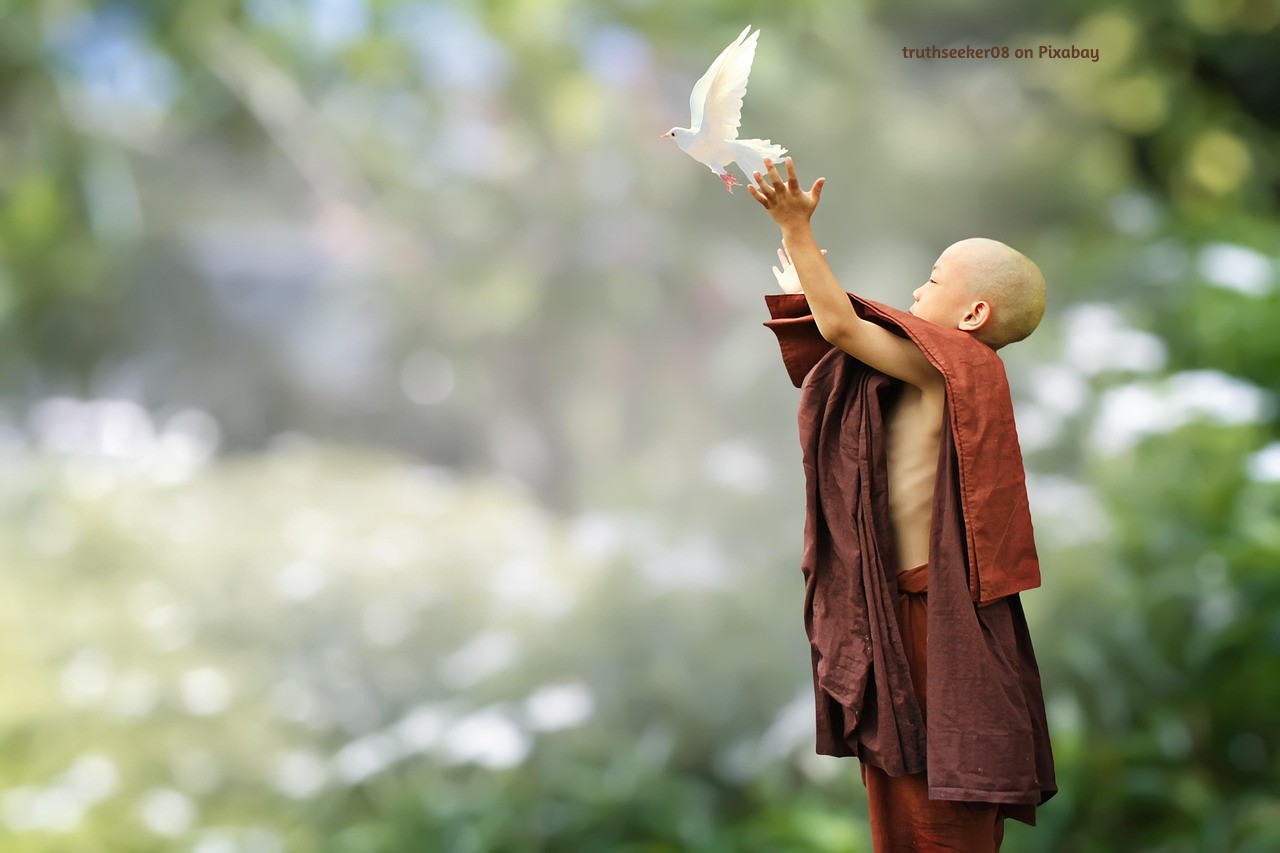
I have the flu, the kind of flu where my body aches with relentless pain, I cannot keep anything down, and getting out of bed takes all the energy I can muster. So, I sleep. And when sleep isn’t possible, I watch endless videos of the monks’ 2300-mile Walk for Peace. And I cry with every video.
I watch the people lined up for miles just to hand the monks a flower. Most are crying – like me.
The monks are walking to Washington DC, our nation’s capitol. They intend to ask the United States Congress to recognize Buddha’s Birthday as a federal holiday.
My response — oh, my! This gives me chills. John Lennon knew that imagining peace wasn’t naïve; it was radical. Our peace-loving monks will ask our governing administration to have the courage to name a day of peace — one day a year where we pause in compassionate awareness and, as Lennon wrote, “imagine all the people livin’ life in peace.”
This, the monks peacefully walking to our nation’s capital and asking for a day of Peace, is an act of courage in a world trained to normalize noise and conflict.
We are a nation steeped in Christianity, and I cannot imagine that this request will land softly, as intended. But the truth is, no matter how Congress responds, no matter how politics posture, the monks have already succeeded. They’ve embodied the answer. They’ve reminded us that peace doesn’t wait for permission.
Some prayers are not answered with yes or no, but with the courage to keep walking.
— Lee Byrd
As I view the videos and watch the people, I cry. Something deep within me is softening. Opening.
This beautiful Walk for Peace offers so much more than the possibility that Congress may listen to the monks’ request — it offers hope. And hope matters. Hope lifts us. It changes how we move, how we respond, how we hold one another.
Psychiatrist and consciousness researcher David Hawkins wrote about this kind of inner shift — not as a measurable frequency, but as a rising field of awareness. As we become more conscious, he taught, we naturally partner more deeply with Source, and our contribution to the world becomes exponential.
Watching this walk reminds me that my job is not to fix the world through external means. My job is to come to peace within myself. And as I do, I notice what no longer serves — worry, anger, fear, resentment — and I sit with what arises. I don’t feed it or deny it. I let it be held in awareness, in the body, in breath. This is the quiet work the monks are pointing to — not force, not argument, but presence. Again and again, as often as needed.
This Walk for Peace reminds me of a longing – to be loved and held just as I am. The Walk reminds me that I am already held, already loved, and that there is nothing more to do.
Nothing to Do
— Papaji
This reflection lives alongside the larger body of work I’m shaping in my forthcoming book, The Seven Gates of Inner Light.